.jpeg)
Northern Alberta palliative team has the backs of patients, families
May 3-9 is National Hospice Palliative Care Week. Many people provide support to terminally ill patients and their families across rural Alberta. In this feature, we take a look at their impact and how it’s evolved.
•••
A Northern Alberta palliative care team is helping make it smoother for all involved when a patient is diagnosed with a terminal illness.
It’s a difficult period for the patient and family as well as health professionals, especially those who aren’t specialists in palliative care, says Tanya Smith, a registered nurse (RN) with Assisted Living Alberta. She works as a palliative care resource nurse in Grande Prairie and the surrounding region.
Nine years ago, Smith joined a palliative care team after working in acute care, emergency, and in a hospice.
“Back in 2017, there really was no palliative care team,” she says.
“I think one nurse was the team. There was another lady that was working in a similar role prior to me, but when she quit, they left the role vacant for quite some time,” explains Smith.
Today, the North Zone Palliative care team has 24 nurses, three nurse educators, two nurse practitioners, and 20 allied health professionals (including occupational therapists, recreation therapists, mental health therapists, respiratory therapists, and social workers) to carry out this responsibility. There are also palliative care physicians.
Smith says the nursing team helps patients, families, and other health providers navigate the challenging world of palliative care with a focus on patient care.
Dr. Rebecca Sherk, who was supported by RHPAP accommodation during her rural clerkship, agrees.
The former RN, who grew up in Valleyview, says she appreciates the collaboration with the palliative care team as she encounters terminally ill patients while practising in Beaverlodge and Grande Prairie.
“I’m eternally grateful when we’re able to use them, because it really makes a difference between a traumatic death and a good end of life process.”
Since Dr. Sherk became a family physician three years ago, she has been fortunate to access the palliative team’s support — something that wasn’t always available to her colleagues.
“I guess palliative care and the families associated with it didn’t get as much one-on-one time. The nurses that we now have involved in the program are very good at giving patients and their families that extra attention.”
Dr. Sherk says the resource nurses can dedicate more time to patients and their families than family physicians and often quickly access needed support within the network.
“Palliative care is a bit of a specialty on its own. It definitely requires some expertise, so it’s not always easy to keep up on the newest recommendations for different symptomatic control,” she says.
“That’s where the patients really benefit in that they can have someone with more direct expertise. We rely heavily on the team to help us out.”
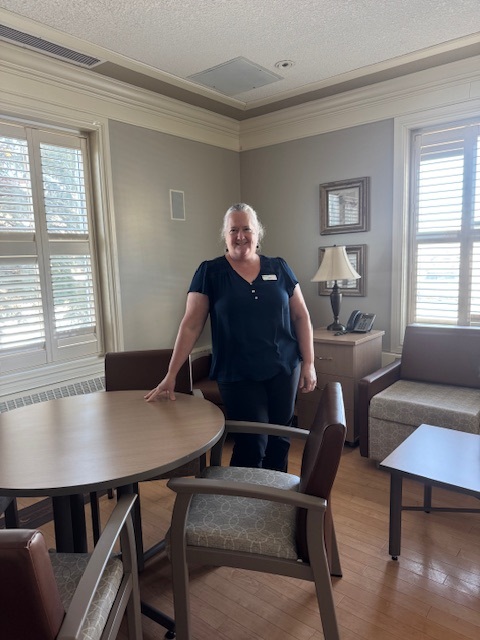
RN Jakie Schmidt typically oversees a caseload of 30 or more clients in High Level and surrounding areas such as La Crete.
“We’re kind of a cog-in-the-wheel that draws in all the other services as needed to provide the best holistic care possible for those clients and families,” says Schmidt.
“We don’t do any hands-on care necessarily, although if you’re in the room with a client, we pitch in for repositioning and things like that, but we’re more of a consult nurse.
“We’re working with all of those disciplines to ensure that patients are getting the care that they require, and that good pain and symptom management is ongoing, and then advocating for those clients.”
Schmidt says a palliative nurse’s job is to support and advocate.
“In other aspects of nursing, we’re doing good things and we’re doing good care, but it’s very fleeting. Our patients are in, then out of hospital.
“My palliative role is a lot of sitting and listening, visiting, having a cup of tea…not something we get to do very often in nursing… to spend time with clients and families to really understand, listen to their journey and…just to be present.
“At the end, I have seen some very beautiful deaths,” says Schmidt, noting one involved 30 family members singing hymns at the bedside.
Keeping the patient’s needs at the forefront is vital throughout the journey.
“That sense of personhood has been lost in the medical system, and we sometimes forget to look at people like they are people,” adds Smith.
“We often look at them as a disease process, when really, especially at the end of their life, they want to be seen as a person.”
“I’m just here to make sure someone has your back.”