.jpeg)
Physician Skills Enrichment
RHPAP helps Drumheller doctor screen for skin cancer
A Drumheller physician hopes to identify skin cancer and other skin conditions more effectively for area residents, saving them from long waiting lists for city referrals.
Dr. Kim Hall just completed her training for Introduction to Dermoscopy, a course that teaches health professionals how to diagnosis benign and malignant skin lesions through the use of a dermatoscope. RHPAP provided funding for the online Cardiff University course through the Physician Skills Enrichment Grant.
The non-invasive instrument uses light and a microscope to view lesions “beneath the skin surface at blood vessels and other structures that you cannot see with the naked eye.
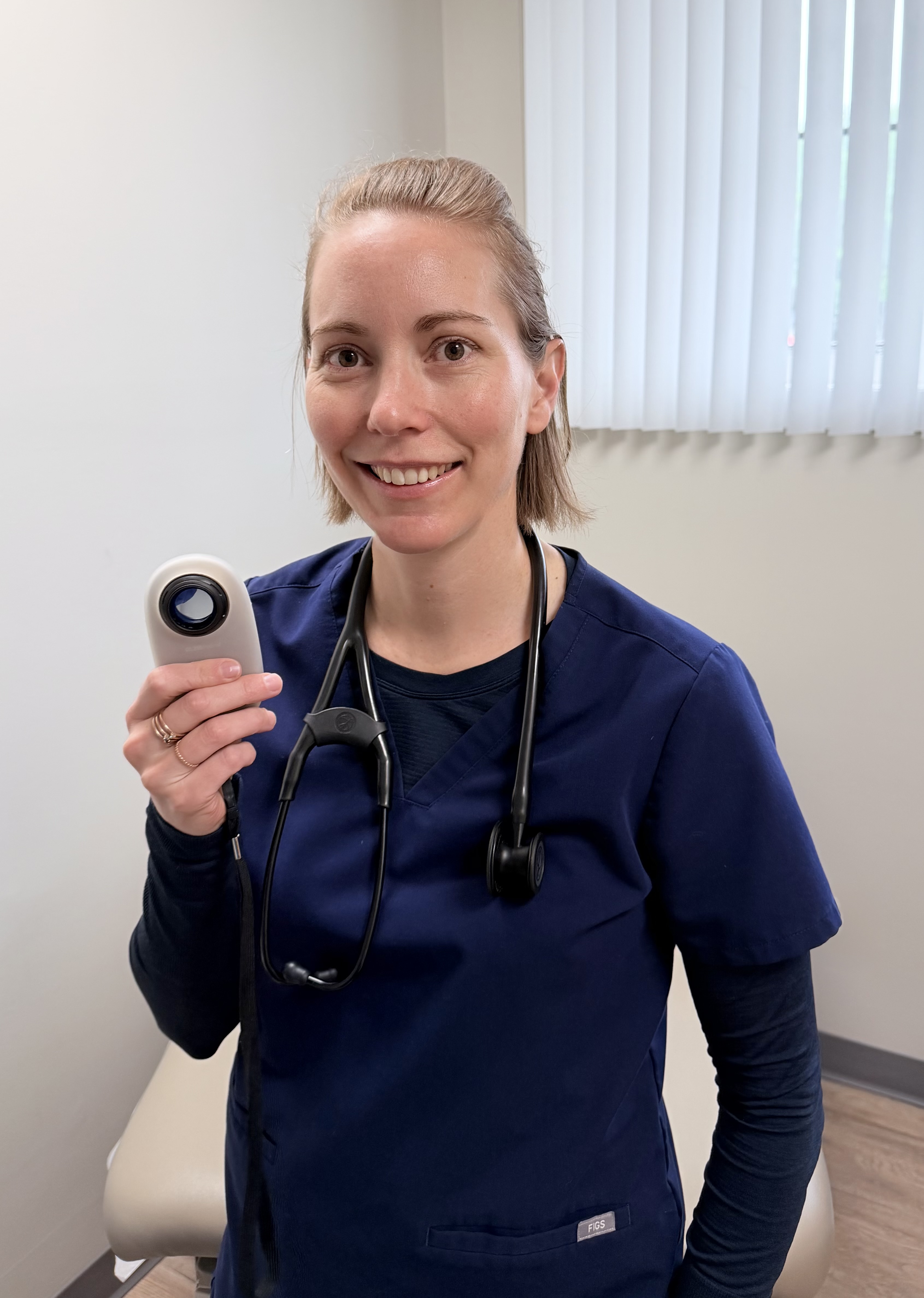
— Photo supplied by Dr. Kim Hall
“We didn’t have anyone that does that in Drumheller and we live an hour and a half from Calgary, which would be our nearest referral centre,” says Dr. Hall, who currently practises as a family physician doing clinic-based family medicine, acute care shifts in a walk-in clinic, hospitalist rotations on an acute care ward, and the care of elderly patients in a continuing care facility.
“That’s over 130 kilometres of travel to the urban centres to access this care and wait times are often more than three months for our patients. We’re sending referrals to the city each week. These challenges are delaying diagnosis and treatment for our patients and then putting additional strain on the team.”
Dr. Hall says it’s unknown whether her community is more at risk since it hasn’t been officially studied, but she suspects it is comparable to other rural Alberta areas.
“We know that UV (ultraviolet) exposure increases skin cancer risk significantly. Then we have other risk factors, as well as genetics.
“We get high sun exposure in the summer which increases the risk of the cancers.”
Waiting for a specialist appointment isn’t ideal as “the longer you wait, the more invasion there can be with these lesions,” she says.
Dr. Hall has been so impressed with the course that she’s signed up for more intensive training to earn her Diploma of Practical Dermatology starting this September. RHPAP will also provide some Physician Skills Enrichment Grant funding for the additional training, which will expose her to a full spectrum of dermatological conditions.
“There is significant financial investment and then a significant time commitment as well. So, it really makes RHPAP support greatly appreciated,” says Dr. Hall.
“I’m learning a lot and I’m really enjoying it. It’s a wonderful opportunity to add to my skill set and support the community, which is wonderful.”
The training is already helpful for Dr. Hall and her patients.
“I had an interesting skin cancer case recently that I was able to assess with the dermatoscope much better than I would have a few months ago. I could clearly see that it looked like a squamous cell carcinoma recurrence in the patient.
“I was able then to refer them to dermatological services … and be able to expedite her review by a specialist. By being able to tell them the dermatoscopic findings, they would be able to fit her in urgently.”
Dr. Hall says the training has become another valuable tool for a rural family doctor.
“I remain a family physician and we always need to be aware of our own limitations. I’m not a dermatologist, and with these complex skin cancer patients, I will not hesitate to get specialist support.”